
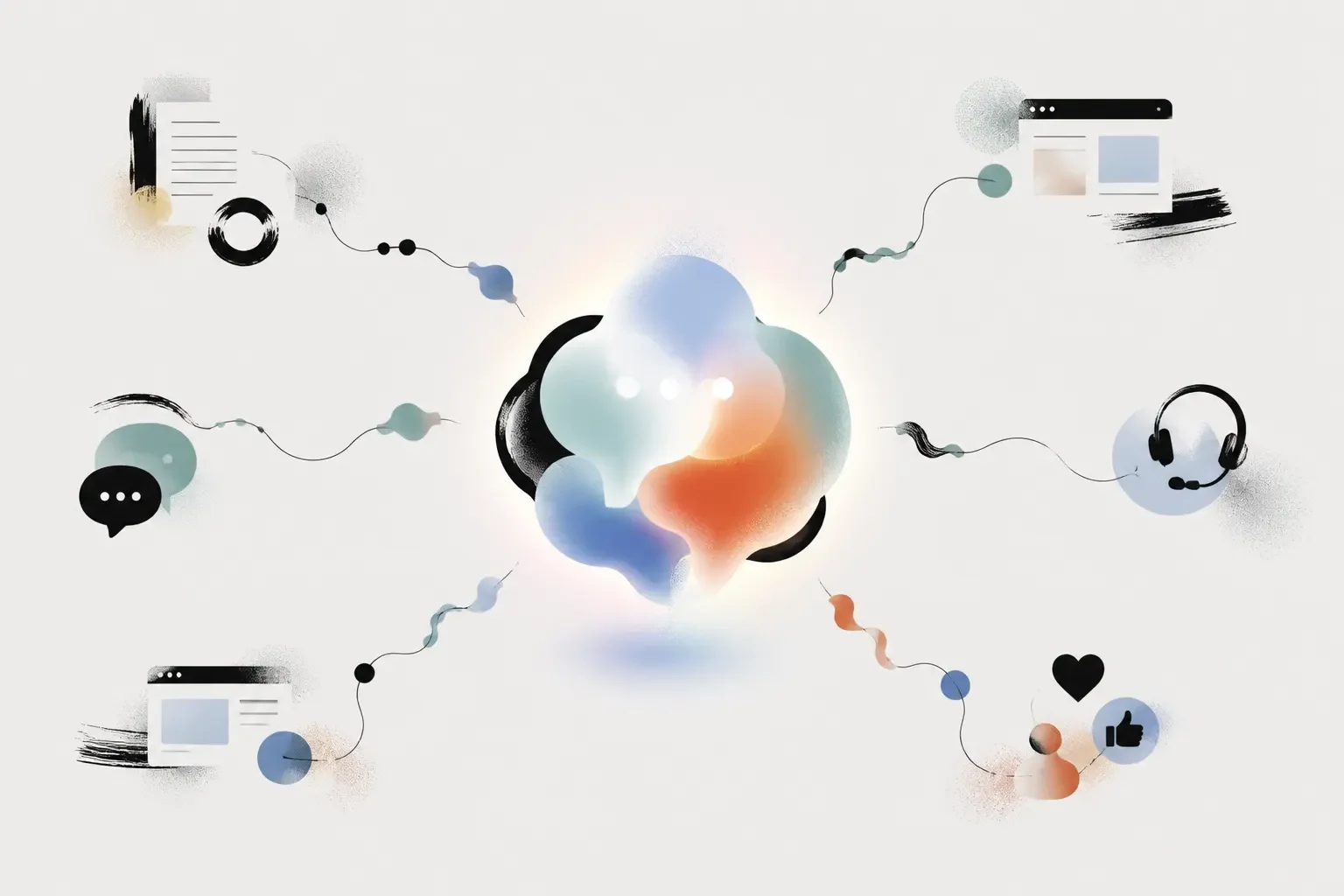
AI chatbots are no longer just tools for answering questions. Today, a good AI chatbot platform can turn content and knowledge bases into conversational experiences, automate customer support, capture leads, connect different channels, and even guide visitors toward the information or product they are looking for.
But choosing a platform is not as simple as comparing prices.
Some tools specialize in customer support. Others focus on building more advanced AI agents. Some turn documents and websites into conversational knowledge bases, while others are especially strong in social media and marketing automation.
That is why, in this guide, we compare 10 of the leading AI chatbot platforms in 2026, looking at ease of use, knowledge sources, customization, channels, AI capabilities, automation, integrations, and pricing.
Prices and features were reviewed in September 2026 and may change as providers update their plans.
The 10 best AI chatbot platforms in 2026
| Platform | Best for | Free plan | Website | Knowledge Base | Link in Bio |
|---|---|---|---|---|---|
| Attlas | Content + conversational experiences | ✅ | ✅ | ✅ | ✅ |
| Chatbase | Knowledge-based chatbots | ✅ | ✅ | ✅ | ❌ |
| Botpress | Advanced AI agents | ✅ | ✅ | ✅ | ❌ |
| Voiceflow | Agent design and development | ❌ | ✅ | ✅ | ❌ |
| Tidio | Customer support | ❌ | ✅ | ✅ | ❌ |
| Landbot | Visual chatbots and automation | ✅ | ✅ | ✅ | ❌ |
| DocsBot | Documentation and knowledge bases | ✅ | ✅ | ✅ | ❌ |
| SiteGPT | Website-based support | ❌ | ✅ | ✅ | ❌ |
| ManyChat | Social media automation | ✅ | ❌ | ❌ | ❌ |
| Crisp | Omnichannel customer support | ❌ | ✅ | ✅ | ❌ |
1. Attlas: Best for turning content into a conversational experience

Attlas is built around a simple idea: instead of forcing visitors to search through pages, documents, and menus, turn that knowledge into a conversational experience.
The platform allows businesses and creators to add links, websites, files, text, images, audio, and video to their knowledge base. Businesses can also define the chatbot's personality, tone, and response guidelines.
Attlas can be used in two particularly interesting ways.
The first is as a website chatbot, helping answer frequently asked questions, guide visitors, and support customer interactions. The second is as an AI-powered Link in Bio experience, where visitors can interact with a creator's or business's content instead of simply browsing through a list of links.
The platform also offers features such as lead capture, Google Calendar scheduling, and human handoff when needed.
Pricing:
Attlas offers a Free plan at $0/month, with no credit card required to get started. The Starter plan begins at $12/month, while the Pro plan is $29/month. Paid plans unlock a broader set of features, including higher message and knowledge limits, more chats, additional history, collaboration, custom domains, and other advanced capabilities. Enterprise plans are available with custom pricing and features.
Key strengths:
- No-code
- Website chatbot
- Knowledge base supporting multiple content types
- AI-powered Link in Bio
- Lead capture
- Meeting scheduling
- Integrations
- Multilingual experiences
- Free plan to get started
Attlas can be used on websites, in bios, through WhatsApp, and even in email signatures, allowing a single link to serve as an entry point to a conversational experience.
Best for:
Businesses and creators that want to turn their content into conversations, instead of offering only a traditional link page or a basic FAQ chatbot.
Potential drawback:
Attlas is broader than a traditional chatbot platform. Because of that, it may not be the most specialized choice for companies looking exclusively for a highly advanced omnichannel customer support system or a deeply technical environment for building complex AI agents.
2. Chatbase: best for knowledge-based chatbots

Chatbase is one of the platforms most directly focused on creating AI agents powered by a company's own knowledge.
The platform works with agents that can use proprietary content and offers features focused on support, integrations, analytics, APIs, and customization. Its Free plan includes 50 message credits per month and one user, while the first paid plan is currently listed at $32 per month when billed annually.
Best for:
Businesses that want to quickly create a chatbot based on documents, website content, and proprietary knowledge.
Potential drawback:
It is heavily focused on AI chatbots and knowledge bases, while platforms such as Attlas extend the experience into other touchpoints, including Link in Bio.
3. Botpress: best for building more advanced AI agents

Botpress is designed for organizations that want greater control over how their agents are built.
The platform provides a visual studio, knowledge bases, APIs and SDKs, integrations with external services, and deployment across multiple channels. Its Pay-as-you-go plan starts at $0 per month and includes $5 in monthly AI credits, while the Plus plan starts at $79/month when billed annually, in addition to AI usage.
The platform stands out when a business needs features such as human handoff, team collaboration, advanced workflows, custom analytics, and greater control over AI agents.
Best for:
Developers, technical teams, and companies that need to build more sophisticated AI agents.
Potential drawback:
The large number of features also means a steeper learning curve for users who simply want to launch a chatbot quickly.
4. Voiceflow: best for designing conversational experiences

Voiceflow is well known for its focus on building and managing AI agent experiences.
The platform provides tools for teams that want to design conversational experiences, test agents, and monitor their performance. Its current pricing structure emphasizes usage-based billing, access to different model providers, and observability and analytics for agents.
Best for:
Product teams, conversation designers, and companies that need detailed control over their conversational experiences.
Potential drawback:
It is closer to an AI agent development platform than a simple "add your content and publish" solution.
5. Tidio: best for customer support

Tidio combines live chat, help desk, automation, and AI in a single platform.
Its Lyro AI Agent is designed to answer repetitive questions and handle part of customer interactions automatically, while more complex conversations can continue with human agents. Current pricing starts at $24.17/month when billed annually for the Starter package, while Lyro can also be purchased separately starting at $32.50/month for 50 AI conversations.
Best for:
Small and mid-sized businesses that want to combine AI automation with human customer support.
Potential drawback:
Its primary focus is customer service and help desk operations rather than turning different types of content into a broader conversational experience.
6. Landbot: best for visual chatbots and automation

Landbot combines visual chatbot building with automation and AI capabilities.
The Free plan includes 100 chats per month, but AI chats are not included. The Starter plan begins at €32/month when billed annually and includes 500 chats and 100 AI chats. Higher plans add integrations, WhatsApp, customization, and more advanced capabilities.
Best for:
Businesses that want to build visually engaging conversational experiences, particularly for marketing, lead generation, and automation.
Potential drawback:
The platform relies heavily on visual flows, making its approach different from knowledge-centered AI chatbot platforms.
7. DocsBot: best for documentation and knowledge bases

DocsBot is closely aligned with the AI knowledge base category.
The platform allows businesses to turn documentation and other sources into knowledge bots. It currently offers a Free plan with one DocsBot, 50 source pages, and 100 AI credits per month. The Personal plan costs $49/month and adds features such as lead capture, scheduling, custom buttons, and Slack integration.
Higher-tier plans add analytics, ticket escalation, help desk capabilities, reporting, sentiment analysis, and enterprise features.
Best for:
Businesses that need to turn documentation, product information, and other materials into a conversational knowledge base.
Potential drawback:
Its positioning is more heavily centered around documentation and knowledge bases than around Link in Bio or content discovery.
8. SiteGPT: best for website-based support

SiteGPT has a very specific proposition: using website content to create an AI support agent.
The platform offers a seven-day free trial. Its Starter plan is currently listed at $59/month when billed monthly and includes one chatbot, up to 4,000 messages, and up to 1,000 pages of content. Higher plans increase message limits, pages, chatbot count, integrations, and analytics.
The platform also offers features such as human escalation, Slack and Zendesk integrations, multilingual support, and automatic content syncing on higher plans.
Best for:
Business websites that need an AI support agent based directly on their documentation and website content.
Potential drawback:
Its focus is narrower than Attlas: SiteGPT is primarily centered around website-based support.
9. ManyChat: best for social media automation

ManyChat occupies a different position from most of the other tools in this list.
Instead of primarily being a website chatbot platform, it focuses on conversation automation across social channels. Depending on the plan, businesses can connect Instagram, TikTok, Facebook Messenger, WhatsApp, and other channels. ManyChat offers a free plan, while paid plans start at $14/month for Essential and $29/month for Pro.
The Pro plan adds AI-powered conversations, advanced automation, broadcasts, and additional channels.
Best for:
Creators and brands that need to automate comments, DMs, campaigns, and social conversations.
Potential drawback:
It is much more focused on social messaging automation than on turning a company's knowledge base into a website chatbot.
10. Crisp: best for omnichannel customer support

Crisp is a customer support platform that combines inbox, live chat, automation, knowledge bases, and AI.
Its Essentials plan currently costs $95 per month per workspace, while the Plus plan costs $295 per month per workspace and adds a more advanced AI-powered support suite with automation, tickets, integrations, and omnichannel capabilities.
Best for:
Businesses that need to centralize multiple customer communication channels and combine human support with automation.
Potential drawback:
It is a broader customer support platform than a simple AI chatbot builder, which can make it more complex for businesses that only need to turn their content into a conversational experience.
Final comparison
After comparing the 10 platforms, there is no single tool that is the best for everyone.
The right choice depends largely on what you want to build.
| Need | Our pick |
|---|---|
| Turning content into conversation | Attlas |
| AI-powered Link in Bio | Attlas |
| Knowledge-based chatbot | Chatbase or Attlas |
| Advanced agents and workflows | Botpress |
| Conversation design | Voiceflow |
| Customer support + live chat | Tidio |
| Visual chatbots | Landbot |
| Knowledge base / documentation | DocsBot |
| Website-based AI chatbot | SiteGPT |
| Instagram and social automation | ManyChat |
| Omnichannel support | Crisp |
What is the best AI chatbot platform in 2026?
The answer depends on your specific goal.
For businesses looking for a platform that turns their knowledge and content into a conversational experience, Attlas stands out through the combination of chatbot, knowledge base, Link in Bio, lead capture, scheduling, and multiple publishing options. The platform also supports different types of content and can be shared through a single link.
For technical teams that need to build complex, highly customized agents, Botpress or Voiceflow may be a better fit.
For businesses whose main challenge is customer support, tools such as Tidio and Crisp provide more comprehensive customer service environments combining human agents and AI.
For organizations that want to turn documentation into conversational knowledge, Chatbase, DocsBot, and SiteGPT are strong options.
How to choose an AI Chatbot
Before choosing a platform, ask yourself these questions:
- Do you need support automation or a broader conversational experience?
A simple FAQ chatbot and an AI agent that can guide users, recommend information, capture leads, and schedule meetings are very different products. - Where will the chatbot be used?
If it needs to live on your website, look for a platform with an embeddable widget and strong customization. If the experience also needs to work as a Link in Bio, that dramatically narrows your options. - What is your knowledge source?
Does the AI need to understand your website, PDFs, videos, documents, social media content, or several of these sources at once? - How much will you use it?
Don't compare only the monthly subscription. Some platforms charge by messages, others by AI credits, contacts, seats, or outcomes. Your actual cost can change significantly depending on usage. - Do you need human support?
For customer service, features such as human handoff, inboxes, tickets, and team collaboration can be just as important as AI quality.
Conclusion
The best AI chatbots in 2026 are not necessarily the ones with the most features.
They are the ones that solve a specific business problem best.
If you need an AI customer support chatbot, Tidio or Crisp may be strong choices.
If you want to build advanced AI agents, Botpress and Voiceflow offer more control.
If you want to turn documentation into conversational knowledge, Chatbase, DocsBot, and SiteGPT are strong options.
And if your goal is to turn business or creator content into an experience that answers questions, guides visitors, captures leads, and can even replace a traditional Link in Bio page with a conversation, Attlas is a particularly interesting option.
Frequently asked questions
What is an AI chatbot platform?
An AI chatbot platform is a tool that allows you to create and publish a conversational experience powered by artificial intelligence without having to build the entire infrastructure from scratch. Depending on the platform, the chatbot can answer questions, access a knowledge base, automate tasks, capture leads, or hand conversations over to human agents.
What is the difference between ChatGPT and an AI chatbot builder?
ChatGPT is a general-purpose AI assistant. An AI chatbot builder is a platform that allows you to create and publish your own conversational experience, typically connected to your content, website, systems, or support channels.
Do I need to know how to code?
Not necessarily. Platforms such as Attlas, Chatbase, Landbot, and Tidio offer no-code or visually oriented experiences, while tools such as Botpress and Voiceflow also provide deeper customization options.
Is there a free AI chatbot?
Yes. Several of the platforms compared in this guide offer free plans or free usage. Attlas offers a Free plan to get started; Chatbase has a Free plan; Botpress offers a $0/month Pay-as-you-go plan with AI credits; Landbot has a Free plan; DocsBot offers Free; and ManyChat also provides a free plan.
What is the best AI chatbot for small businesses?
For a small business, I would start by comparing Attlas, Tidio, Chatbase, Landbot, and DocsBot. The best choice depends on whether the main goal is customer support, lead generation, knowledge management, automation, or a broader conversational experience.
AI brain with humans in the loops