

The problem every chat faces: where do you start?
Every intelligent chat faces the same challenge in the very first seconds.
The user opens the chat… and freezes.
Without guidance, they see a blank screen, a text input, and need to make a decision: “What should I ask here?”
When that answer doesn’t come quickly, the conversation never starts.
And without conversation, there is no value, no matter how good the content behind the chat may be.
That’s exactly the problem Attlas Triggers are designed to solve.
What are Triggers in Attlas?
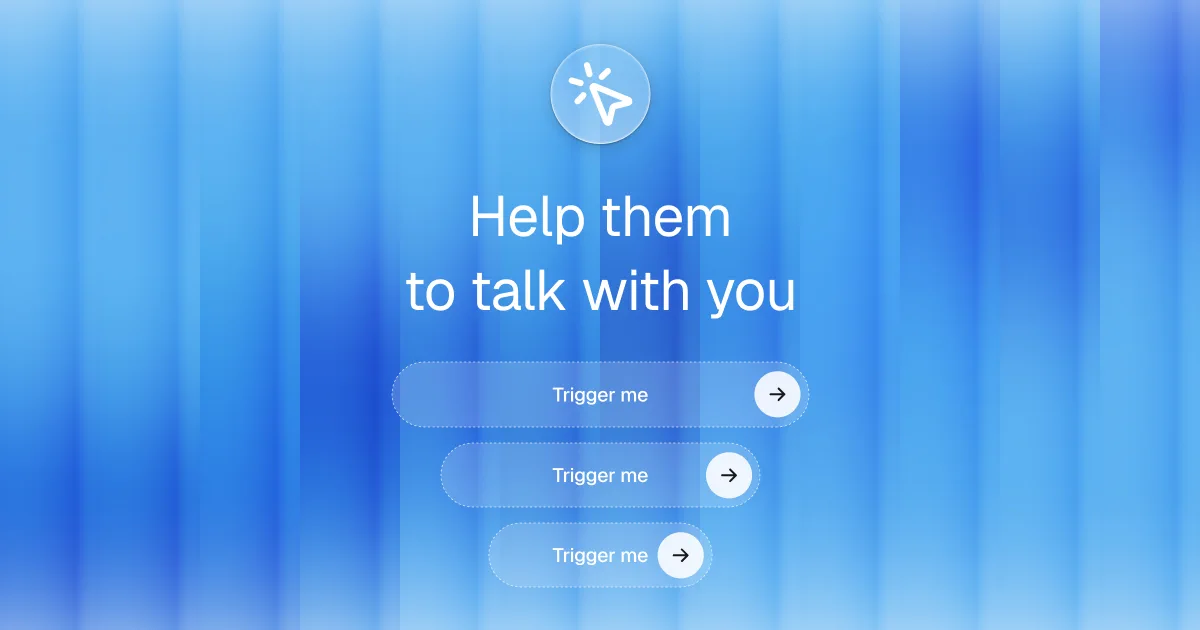
Triggers are interactive buttons that appear in the center of your chat and act as starting points for the conversation.
They can be questions, links, media, or actions that invite the user to interact immediately.

More than a visual element, triggers are a way to guide the user, showing what’s possible inside that chat.
They remove the burden of the first decision and turn curiosity into action.
Why Triggers are essential for conversations to happen
A common mistake is treating triggers as something secondary, just “nice-looking buttons.”
In practice, they are one of the most strategic elements of a chat.
Well-designed triggers:
- Increase interaction in the first few seconds
- Reduce chat abandonment
- Help users quickly understand what that Attlas is for
- Guide the conversation toward the most important content
They work as a clear invitation: “Start here.”
Good Triggers spark curiosity, and curiosity creates conversation
Here’s the most important point: not every trigger works.
Effective triggers aren’t just descriptive, they’re curiosity-driven.
Compare:
- “About us”
- “What we do”
with:
- “How did this project start?”
- “What do most people know about us?”
The second group creates interest.
And interest leads to clicks.
Clicks lead to conversation.
The more curiosity a trigger sparks, the higher the chance the user will interact, and stay in the chat.
Creating good trigger buttons is, above all, an exercise in empathy: what would make someone want to click here right now? What would make someone want to learn more about me or my project?
Triggers also organize the experience
Beyond starting conversations, triggers help structure your Attlas content.
They allow you to highlight:
- Priority information
- Important links
- Content you want to be discovered first
Instead of dumping everything into the chat and hoping the user asks the right question, you guide the experience in a simple, intuitive way.
Not as a rigid menu, but as possible paths.

What if I don’t know which questions to create?
This is a common concern, and completely normal.
Not everyone immediately knows which questions spark the most interest. That’s why Attlas offers automatic trigger generation.
With just a few clicks, you can generate suggested questions based on your own content.
These suggestions aren’t meant to replace your thinking, but to unlock the creative process.
You can:
- Use the questions as they are
- Adapt them to your tone
- Combine them with your own ideas
- Discard anything that doesn’t make sense
What matters most is avoiding a chat that starts with nothing. Here is an example:
Triggers make a difference because they guide, not push
At Attlas, we believe information shouldn’t be pushed, it should be discovered.
Triggers don’t force users down a path.
They simply show possibilities.
They respect the visitor’s pace, while making the experience clearer, more welcoming, and more interactive.
That’s what turns an empty chat into a real conversation.
Triggers are the first step toward a chat that works
At the end of the day, triggers play a simple yet powerful role:
- They help the conversation begin
- And when the conversation begins, the value appears

Published author and writer specializing in digital communication. She turns ideas into texts that help people enjoy and discover the full potential of Attlas.