

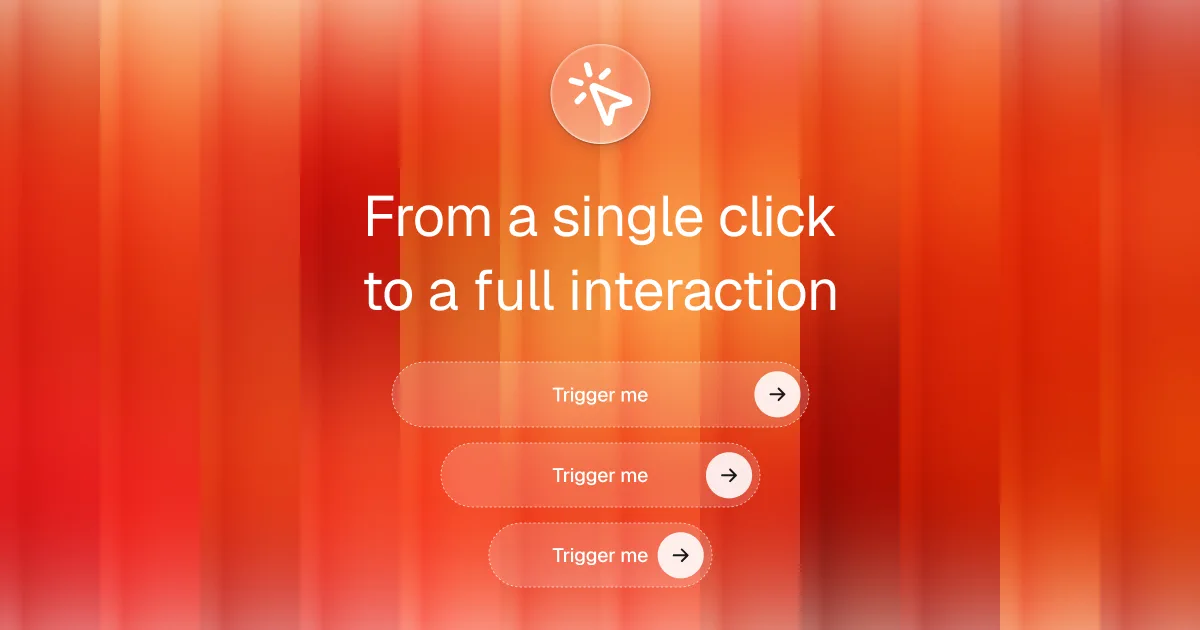
Triggers were born from something very simple, and very honest: silence.
When we started observing how people interacted with an Attlas chat for the first time, a clear pattern emerged. Users would arrive on the site, open the chat… and stop there.
The chat was technically perfect:
- A familiar conversation field, like WhatsApp
- A clean interface
- All the knowledge properly loaded
But the conversation simply didn’t start.
People saw a blank screen and a text input. And they didn’t know what to do.
The first big realization: why weren’t people asking Attlas anything?
We paused and asked ourselves a fundamental question:
Why would someone ask something if they don’t really know where they are or what that chat is for?
We realized the problem wasn’t a lack of interest, it was a lack of provocation.
For someone who had never used Attlas before, that chat could feel like:
“A place to ask anything.”
But that creates a paradox:
- To ask something, you need context
- To understand the context, you need to interact
- But without an initial interaction, nothing happens
The insight: a conversation needs a first move
That’s when we understood something essential: a conversation cannot rely only on the user’s initiative.
It needs an invitation.
Not a tutorial.
Not a long explanatory text.
But something simple, intuitive, and almost instinctive.
That’s how trigger buttons were born.
We chose buttons because they remove the initial cognitive effort.
A button:
- Is visible
- Is clickable
- Communicates intent
- Sparks curiosity
Even if someone lands on an Attlas from a company or creator they’ve never seen before, the buttons guide them and show where to start.
They don’t require the user to know what to ask.
They show what can be asked.
Triggers as the main engine of interaction
Over time, it became clear that triggers were more than just a UX detail.
They became the main interaction engine of Attlas.
Not in a technical sense, but in a human one.
They are what:
- Break the ice
- Spark curiosity
- Turn passive visitors into active participants
Today, internally, we see triggers as one of the most powerful parts of Attlas, because they’re what actually make conversations happen.
The natural evolution of triggers
As we observed real-world usage of the platform, we realized something else:
People wanted more than just question buttons.
They wanted to:
- Group important links
- Share social media profiles
- Highlight videos, music, or documents
- All while preserving the essence of Attlas: accessible, simple, and organized information.
That’s how triggers evolved into something bigger.
Today, they allow you to bring together:
- Interactive questions
- External links
- Spotify songs
- YouTube videos and channels
- Google Drive files
- Documents and media
All in one place.
Not as a static list, but as entry points to the conversation. Here is an example:
Triggers are the first “hello” of your chat
In the end, triggers serve a very simple purpose: they say “hello” before the user even types a single word.
And that changes everything.

Published author and writer specializing in digital communication. She turns ideas into texts that help people enjoy and discover the full potential of Attlas.