

Probably a large portion of the Brazilian population, and even globally, has had frustrating interactions with customer service chatbots on the internet. But why does this happen? What is wrong with traditional chatbots?
These tools, which emerged as a promise of agility and modernization in customer service, ended up becoming synonymous with headaches for many consumers. In this article, we will present real data and answer the million-dollar question: why do we hate talking to chatbots?
Main problems with traditional chatbots
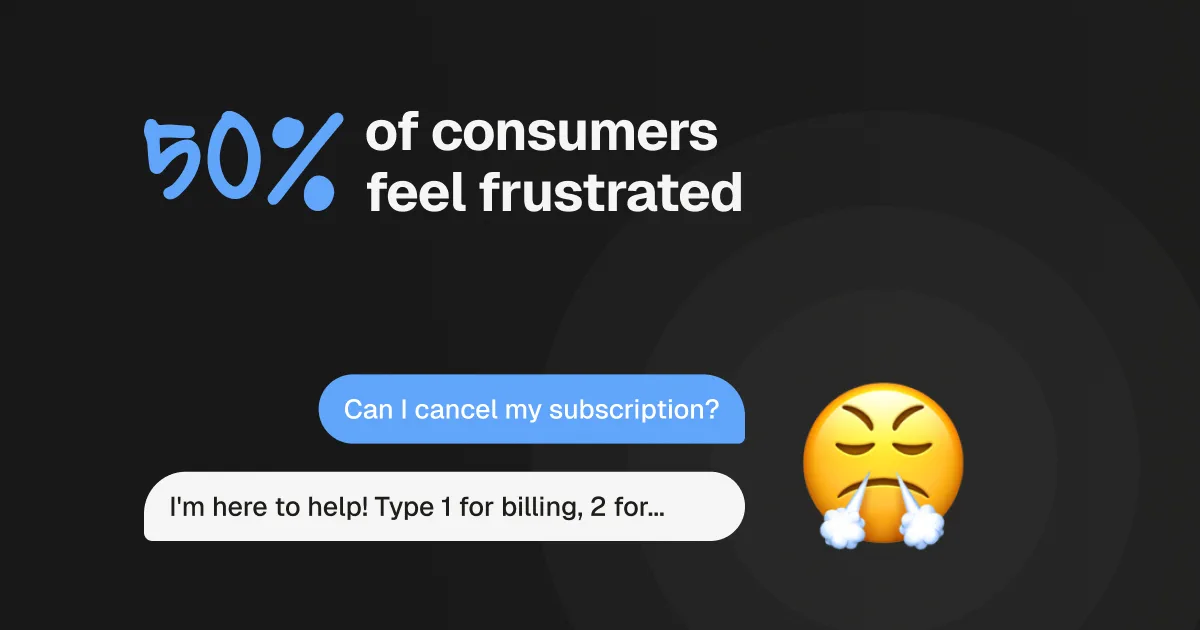
Over 50% of consumers feel frustrated with chatbots
A global survey conducted by Forrester in partnership with Cyara showed that consumers give an average rating of 6.4/10 for experiences with chatbots, and 50% say they often feel frustrated with this type of service. Another study, by Verint (2024), revealed that more than two-thirds of users have had bad experiences with bots.
In Brazil, the data follows the same trend: according to Octadesk and Opinion Box, 36% of Brazilians reported negative experiences with chatbots, and 51% said that it is essential to have the option of speaking to a human representative.
Chatbots do not understand complex questions
Much of consumer anger stems from the fact that bots cannot understand more elaborate or off-script questions. An alarming number: 75% of customers say that chatbots are not good at dealing with complex problems.

In addition, 62% of consumers consider the experience unsatisfactory when the bot does not understand their request. This is because many generic bots are pre-programmed, unable to interpret nuances, slang, language variations, or even emotions.
Lack of empathy and personalization
Another major problem is that bots sound like robots. They are cold, impersonal, and limited. Users feel like they are talking to an automated system, rather than someone who genuinely cares about helping them.
This is where people who would much rather go to a physical location to solve their problem and talk to someone come in, rather than accessing a website and getting frustrated with a robot that doesn't understand what they are going through.
No option to speak to humans
Imagine trying to solve an urgent problem and discovering that there is no way to exit the chatbot and speak to a real person. This is more common than it seems.
According to studies, 67% of consumers expect to be transferred to a human when necessary, but many companies do not offer this option clearly or quickly. The result? Customers abandon the company. One study found that 30% of consumers give up on a brand after a bad experience with a chatbot.
The impact on business: cart abandonment and loss of trust
The problem goes beyond irritation: frustrated customers don't buy. Data shows that:
- 45% of consumers abandon their purchase if their questions are not answered quickly;
- 56% switch brands after a bad customer service experience;
- And 43% say their biggest complaint about digital customer service is ineffective chatbots.
In other words, frustration with bots directly affects sales, reputation, and brand loyalty.
What's wrong with generic chatbots?
In summary, the most common mistakes that make people dislike bots are:
- Rigid flows: they cannot deviate from basic scripts.
- Lack of intelligence: they do not understand non-standard questions.
- Inability to escalate: they don't transfer to a human attendant.
- Impersonal communication: cold, repetitive, and unempathetic responses.
- Confusing interface: they make navigation difficult and delay problem solving.
These factors turn what should be quick service into a veritable digital maze.
How does Attlas solve this problem?
Unlike generic chats with canned responses, Attlas transforms organized content into useful, clear, and relevant conversations. It adapts to what you teach and responds based on the information you choose to share. See what Attlas does differently:
- Understands complex questions about the content provided
- Uses its knowledge to respond accurately
- Customizes responses according to each context or even language
- Creates more natural and efficient conversation experiences
With this, Attlas eliminates the number one reason why people dislike bots: inefficiency.
In conclusion, the problem is not with the technology itself, but with how it is applied. Many people have had frustrating experiences with automated chats that do not understand questions or limit responses too much, and this ends up alienating people.
Fortunately, there is a better way to automate customer service. With Attlas, you can create useful, personalized, and efficient conversations that really help. At the end of the day, what everyone wants is customer service that works. It's that simple.
As simple as Attlas.

Published author and writer specializing in digital communication. She turns ideas into texts that help people enjoy and discover the full potential of Attlas.