

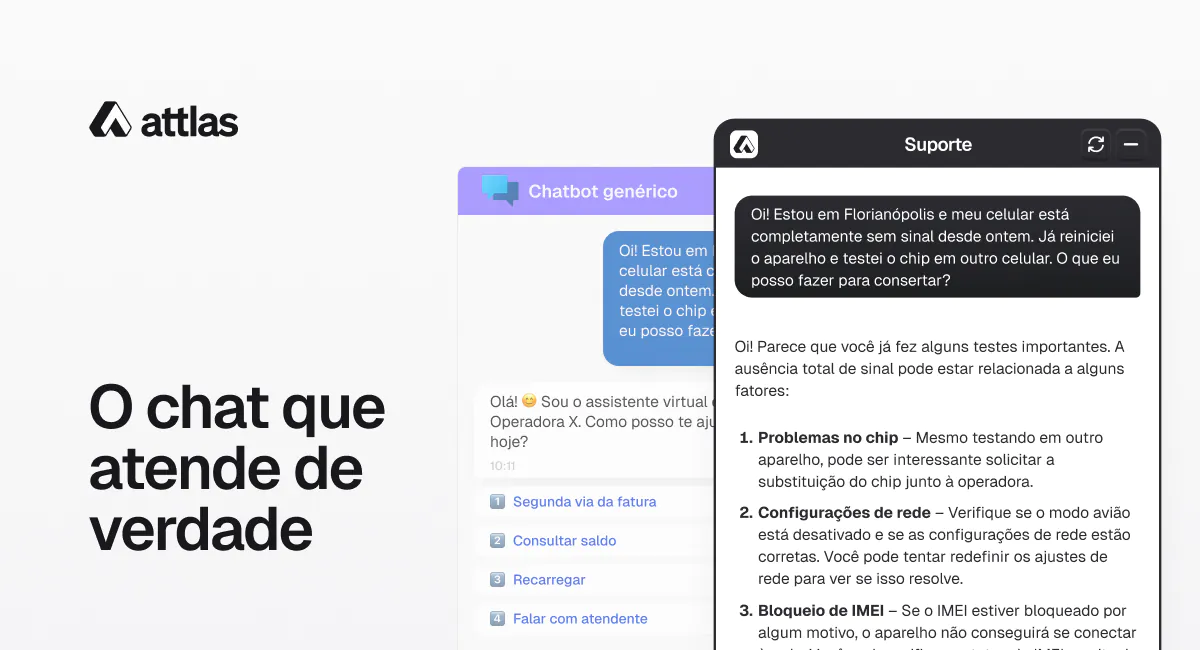
You've probably been through this: you visit a website, receive an automatic greeting such as "Hello, how can I help you?" and, when you send your question, you receive a generic response. Then you wait. And wait. Until you give up.
The truth is that generic chats are still the reality on many websites and companies and, in practice, leave those seeking help even more lost and even frustrated.
That's where Attlas comes in.
Why do so many chats still fail?
Most bots we see out there still work based on pre-programmed flows. They try to predict what customers will ask, but rarely get it right. When the question strays from the script, the conversation stalls. The solution? Forward it to a human agent, if one is available.
Meanwhile, the customer waits... or gives up.
Even with increasingly modern forms of customer service, there are still people who struggle with technology. Older people, for example, often have more complex questions that a chat based solely on pre-programmed FAQs cannot resolve, and that's where many companies end up losing out. They lose customers, credibility, and trust.
It is at times like these that automated customer service begins to be hated: because most robots simply do not solve anything. In the end, they seem to be there just for show, but in practice, they end up making everything more difficult for those who need help.
As I mentioned, there are problems that require special and more advanced attention. Let's look at an example:

This is the type of question that requires contextual interpretation and access to specific data, something that Attlas would be able to understand and answer if it had been trained with company information, while a bot with programmed questions would be lost outside of its script.
Companies that use generic chats are not only saving money poorly: they are missing out on real sales and loyalty opportunities. In a world where consumer attention lasts only a few seconds, slow service is synonymous with quick abandonment.
People want quick and useful answers! They want their problems and questions to be resolved.
Attlas: the chatbot that learns from your company
While traditional chatbots are still stuck with scripts and buttons, Attlas learns from your files, links, and documents, thoroughly understands your company's content, and answers questions based on that. In other words, it doesn't need to be programmed with all possible questions and answers; it generates real answers in real time based on the information you provide.
In practice, this means:
- Contextualized conversations that make sense
- More complete answers, even for more difficult questions
- Reduced demand for human service
- More satisfied and confident customers
It responds with clarity, objectivity, and context.
As new customer questions arise and new problems require new explanations, simply update the materials and answers, and Attlas learns again.
With Attlas, the customer experience is fluid. Service happens where and when they want it, with precision. What's more, customers feel truly heard and understood because they are talking to a chatbot that knows what it's talking about.
And of course, if at any point you want to keep human agents, Attlas can be integrated into your workflow, acting as the first intelligent filter and saving your team time.
Intelligent chatbot? Only if it's Attlas.
If your company wants to offer truly intelligent and accessible customer service, the answer is not to program every question in the world. It's to organize the knowledge you already have and let Attlas take care of the rest.
Attlas doesn't follow ready-made scripts. It creates intelligent conversations.
And that's not just a technological advantage, it's a revolution in the way companies communicate.

Published author and writer specializing in digital communication. She turns ideas into texts that help people enjoy and discover the full potential of Attlas.